In the past, the booking of Botox appointments by individuals in their twenties prompted widespread skepticism. However, this has become increasingly common. The demand for aesthetic treatments aimed at prevention among younger patients has been nothing short of a revelation. It is not a trend based on narcissism, but rather a real shift in mindset about aging, and one that is supported by science – in fact it’s best to start early.
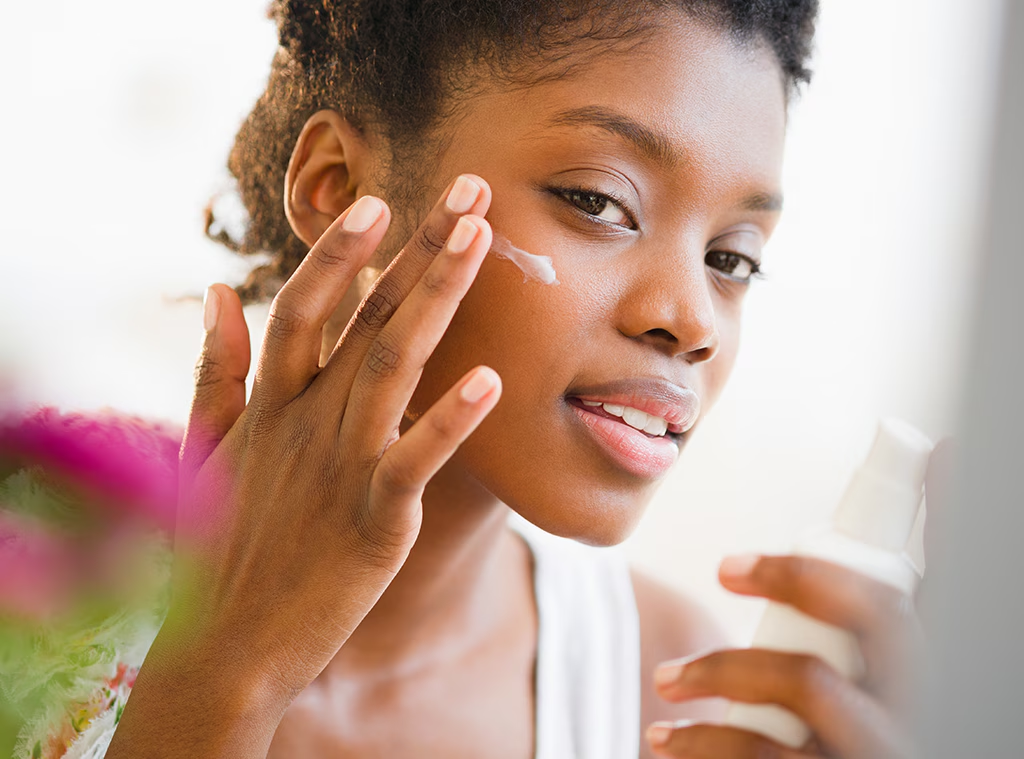
Why This Generation Started Early
If you look at the science of why some aesthetic treatments work best as a preventative, it makes sense. “The skin is like a piece of paper that we fold in half, then fold in half again, and more times, it’s going to weaken and create a wrinkle,” says Linda Blahr, Head of National Training at SkinCeuticals. “Dynamic wrinkles, caused by movement like frowning or raising your eyebrows, turn into static wrinkles over time and unnecessarily deepening your creases in your 20s or 30s will only accelerate that process.”
Other treatments can block that damage, sometimes for years to come. Pigment treatments like lasers can be much harder to deal with if you’ve had them for years, while filler in the cheeks can to some extent prevent or delay the need for a facelift (if that’s a step you’re considering once older).
This makes it fair to wonder if the whole aesthetic model isn’t due for an overhaul. The traditional one is built around the idea of an eventual dramatic transformation, after a certain age, when you’ve ‘let yourself go.’ But what if, with the right early interventions, you don’t even have to hit the operating table at all.
The Biology Behind Starting Young
Here’s the part that is drowned out by social media: collagen and elastin production begin to decline in your mid-20s, not at 40. This decline is gradual and undetectable at first. You won’t notice deep wrinkles at 26, but the foundation for them is settling in.
This is why the preventative argument stands up medically, not just financially. Treating skin while it still has good elasticity and minimal sun damage is fundamentally easier than trying to reverse years of collagen loss. It’s the difference between maintaining a solid foundation and reconstructing one that’s already falling down.
Sun exposure is still the single biggest preventable ager. Years of UV damage will cause fine lines, uneven pigmentation, and loss of skin texture decades before “normal” aging would. No injectable will cancel out years of unprotected sun exposure. It can only work in conjunction with better behaviours, not instead of them.
Why The Practitioner Matters More Than The Treatment
None of this is risk-free when not overseen by a medical professional. Low-dose doesn’t mean low-risk if given by someone who isn’t properly trained, and “preventative” treatments still involve needles, active ingredients, and real tissue response. A provider should take into account your skin type, your lifestyle, how much sun you’ve had, and your desired look. For anyone considering these early interventions, booking a consultation at a medically-led clinic like Dr Amy Law Aesthetics Clinic in Liverpool ensures the treatment plan is tailored safely to your skin rather than sold as an off-the-shelf package.
A clue that an experienced practitioner is doing everything they can to avoid risk is that they have turned clients away for being too gung ho. Or that you don’t notice immediately. The cheapest treatment in town might not look risk-free. Great deals aren’t always worth exactly what you paid.
What Preventative Treatments Actually Look Like
Younger patients are seeking treatments that are deliberately minimal. This is not about altering their appearance in a drastic way.
- Low-dose neuromodulators are used to relax the tiny facial muscles associated with facial lines and prevent these lines from becoming too deep while the skin is still in the process of recovering itself.
- Skin boosters like Profhilo deeply hydrate the skin and kick-start the skin’s natural collagen and elastin production to increase its firmness, without adding any extra volume to it.
- Microneedling causes tiny micro-injuries that stimulate the skin’s self-repair mechanisms to produce collagen and elastin to improve its texture and even out its tone.
- Light chemical peels help remove the dull layer on the surface and promote cellular regeneration, making the skin appear healthier and reducing minor sun damage while it’s still superficial.
All of these treatments work with the skin’s repair mechanisms rather than against them, which is what prevention is really all about – coaxing the skin into doing what it does best while it’s still young, rather than undoing all the damage when it ages.
Setting Expectations That Actually Hold Up
Preventative treatments don’t stop time in its tracks. Someone isn’t 27 forever because they had a skin booster. What it can do is slow the visible progression of ageing, and reduce how much correction you might need later on.
This is not magic. It’s a realistic useful outcome. It’s also why professional treatment can’t replace daily habits. SPF, retinol, and consistent hydration are doing quiet, cumulative work every single day, and no in-clinic procedure compensates for skipping them.
Think of professional treatments as reinforcement, not substitution. The people getting the best long-term results are combining both. Skip one half of that equation and the other works twice as hard for half the payoff.
Preventative skincare isn’t about outrunning age. It’s about giving your skin the best possible starting position for the decades ahead, and choosing the right hands to help you do it.


