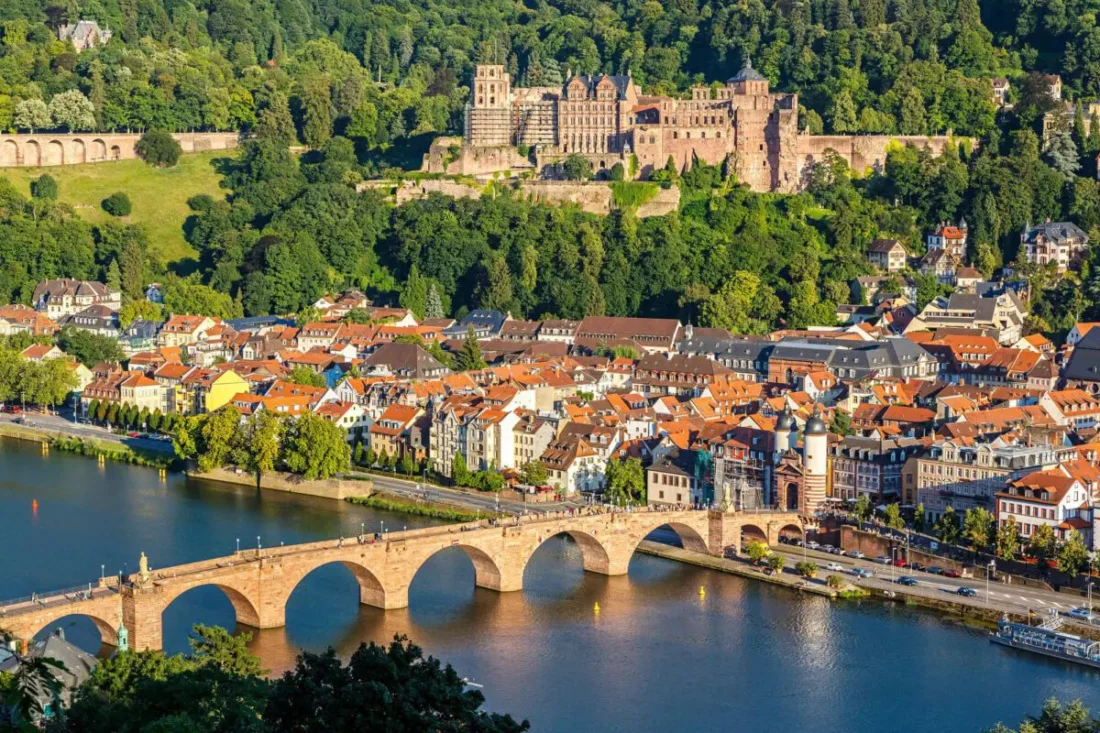
Heidelberg has a way of making a strong first impression. You come around a bend on the Neckar River, look up, and there’s a half-ruined castle sitting on a hillside like it’s been waiting for you specifically. Then you walk into the Altstadt and realize the whole town looks like that: pastel facades, cobblestone lanes, a university that’s been running since 1386.
If this is your first trip here, this guide covers what actually matters: how to get in, what to see, where to eat, how much time to set aside, and the small details that trip up first-timers.
A Quick Orientation
Heidelberg sits in southwest Germany, in the state of Baden-Württemberg, right where the Neckar River opens up into the Rhine plain. It’s a small city by German standards, home to roughly 160,000 people, but it punches well above its weight in visitors because of two things: the castle and the university.
Everything a first-time visitor cares about is packed into a walkable stretch along the river:
- Altstadt (Old Town) – the historic core, home to Market Square, the Church of the Holy Spirit, and most restaurants and shops
- Heidelberg Castle – on the hillside above the Old Town, reachable by foot, funicular, or car
- Neuenheim – across the river, quieter, good for an evening walk
- Bergheim and the station area – more modern, useful if you’re staying near the Hauptbahnhof
You could genuinely see the highlights in a single focused day, but two days lets you slow down, which is really how this city is meant to be experienced.
Related: Best 5 ideas to find cheap business class from the US to Europe
Getting to Heidelberg
Heidelberg doesn’t have its own airport, so almost everyone arrives through Frankfurt Airport (FRA), which sits about 80 km to the north.
1. By Train
This is the most popular option. Direct ICE and IC services connect Frankfurt Airport’s long-distance station to Heidelberg Hauptbahnhof, with the fastest trains covering the route in under an hour. Regional connections run more frequently but take a bit longer since they involve a change.
2. By Car or Private Transfer
Driving takes around 45 minutes to an hour depending on traffic on the A5, and it’s the easiest option if you’re arriving with luggage, jet-lagged, or traveling as a family.
A lot of visitors coming straight off a long-haul flight prefer to book a private transfer in advance rather than deal with station transfers and platform changes, and if that’s the route you want to take, this page to booking an airport transfer from Frankfurt to Heidelberg walks through how the door-to-door service works.
3. By Bus
FlixBus and similar operators run budget routes between Frankfurt and Heidelberg, usually the cheapest option but also the slowest.
Once you’re in Heidelberg itself, you won’t need a car. The Old Town is pedestrian-friendly, and trams and buses cover everywhere else.
Getting Around Once You’re There
- Walking covers 90% of what you’ll want to see. The Altstadt is compact and mostly flat until you start climbing toward the castle.
- The Bergbahn (mountain railway) takes you up to the castle and, if you keep going, all the way to the summit of the Königstuhl. It’s one of the oldest funicular lines in Germany and still runs some original carriages.
- Trams and buses run by the RNV network connect the Old Town, the station, Neuenheim, and the surrounding neighborhoods. A day ticket is worth it if you’re covering ground.
- Bikes are a solid option along the riverside paths if you want a change of pace from walking.
Heidelberg Castle: What to Know Before You Go
The castle (Heidelberg Schloss) is the reason most people come. It’s a partial ruin rather than a fully restored palace, and that’s actually part of the appeal. Sections were destroyed by fires and wars over the centuries, and rather than rebuild everything, the city left much of it as is.
A few practical points:
- The castle courtyard is free to enter, but you’ll pay for access to the interior rooms and the Great Vat, the enormous wine barrel that’s become a bit of a running joke among visitors.
- Guided tours through the casemates and underground passages run seasonally and are worth booking if history is your thing.
- You can walk up from the Old Town (steep in places), take the funicular, or drive up. The funicular is the easiest option for most visitors.
- Give yourself at least two hours if you want to see the grounds properly, longer if you’re doing an interior tour or the museum.
- For the best photo of the castle itself, head to the Schlangenweg viewpoint on the way to the Philosophers’ Walk. It’s a short detour and gives you the classic postcard shot of the castle against the Old Town.
The Old Town (Altstadt)
This is where you’ll spend most of your time, and it rewards slow wandering more than a checklist approach.
Marktplatz (Market Square) is the civic heart of the Old Town, anchored by the Church of the Holy Spirit (Heiliggeistkirche), a Gothic church that’s dominated the square since the 14th century. It’s still an active church, and you can climb the tower for a view over the rooftops.
Hauptstrasse is one of the longest pedestrian shopping streets in Europe, running the length of the Old Town. It’s a good spine to orient yourself around, with side streets branching off toward the river or up toward the castle.
Heidelberg University shows up everywhere here, since it’s woven directly into the Old Town rather than sitting on a separate campus. Two spots worth seeking out:
- The Old University building on Grabengasse, which houses a small university museum
- The Student Jail (Studentenkarzer), used to lock up unruly students between 1778 and 1914. The walls are covered floor to ceiling in decades of student graffiti and it’s one of the more unusual things you’ll see in the city.
Haus zum Ritter is worth a glance too. It’s one of the few buildings in the Old Town to survive the wars of the late 1600s largely intact, and its carved red sandstone facade dates back to 1592.
The Old Bridge and Philosophers’ Walk
The Alte Brücke (Old Bridge) crosses the Neckar at the eastern edge of the Old Town, framed by a striped medieval gate tower. At the bridge entrance you’ll spot a bronze monkey statue holding a mirror. Local tradition says touching the mirror brings good luck and wealth, so don’t be surprised if there’s a small queue for photos.
Cross the bridge and you’ll find the start of the Philosophenweg (Philosophers’ Walk), a path along the hillside on the north bank named for the professors and students who supposedly used it for quiet reflection. The climb up is a bit of work, but the views back across the river to the castle and Old Town are some of the best in the city, and there’s noticeably less foot traffic up here than down in the Altstadt.
Where to Eat and Drink
Heidelberg’s food scene leans toward traditional German and regional Baden cuisine, with a strong student-town beer hall culture layered on top.
- Traditional brewhouses around the Old Town serve hearty regional dishes like schnitzel and Palatinate-style sausages, usually in atmospheric, centuries-old buildings with long communal tables.
- Riverside cafés along Neckarstaden are ideal for a slower coffee or drink while watching boats pass by.
- Local bakeries are worth seeking out for a proper pretzel, especially if you’re heading up to the castle and want something to eat on the way.
- Look for a Studentenessen (student meal) menu at lunch if you want a filling, budget-friendly option near the university.
Best Time to Visit
- Spring (April to June) brings mild weather and blooming gardens, before the peak summer crowds arrive.
- Summer (July and August) is the busiest and warmest stretch, with long daylight hours and outdoor seating everywhere, but also the largest crowds at the castle.
- Autumn (September and October) offers good weather with noticeably fewer tourists, arguably the sweet spot for a first visit.
- Winter is quiet and atmospheric, especially around the Christmas market in December, though several outdoor attractions run reduced hours.
Where to Stay
- Old Town (Altstadt) puts you within walking distance of everything and is the most atmospheric choice, though prices reflect the location.
- Neuenheim, across the river, is quieter and more residential, with good tram links back into the center.
- Near the Hauptbahnhof is a practical, budget-friendly base, especially useful if you’re arriving or leaving by train and want to minimize transfers.
A Simple First-Time Itinerary
Day One: Start in the Old Town around Marktplatz, visit the Church of the Holy Spirit, wander Hauptstrasse, and explore the university quarter including the Student Jail. Cross the Old Bridge in the afternoon and rub the monkey statue for luck. Grab dinner at a traditional brewhouse.
Day Two: Head up to Heidelberg Castle via the Bergbahn in the morning, before the crowds build. Walk the grounds, take the interior tour if you’re interested, and stop at the Schlangenweg viewpoint on your way to the Philosophers’ Walk. Spend the afternoon on the north bank in Neuenheim, then wind down back along the river.
If you only have one day, prioritize the Old Town in the morning and the castle in the afternoon, when the light is better for photos looking back over the rooftops.
Practical Tips for First-Timers
- Money: Germany is still fairly cash-friendly, especially at smaller cafés and market stalls, so carry some euros alongside a card.
- Language: English is widely spoken in the tourist areas and around the university, but a few basic German phrases go a long way with locals.
- Footwear: Cobblestones and hills are the norm here, so comfortable shoes matter more than they might elsewhere.
- Day trips: If you have extra time, Bad Wimpfen, a small medieval town about 1.5 hours away by train, makes for a pleasant half-day trip.
- Tickets: Book castle interior tickets and any guided tours in advance during summer, since queues can build up quickly on weekends.
- Date Calculator: When planning your itinerary, a date calculator can help you quickly determine the number of days between your arrival and departure, making it easier to organize hotels, activities, and transportation.


