Understanding how visitors interact with a website is essential for improving user experience and conversion rates. A website heatmap turns visitor behavior into a visual, color-coded map, showing where users click, how far they scroll, and which areas attract the most or least attention. Modern heatmap platforms are already used at significant scale: Hotjar reports being trusted by more than 1.3 million websites and apps across 180+ countries in 2026.
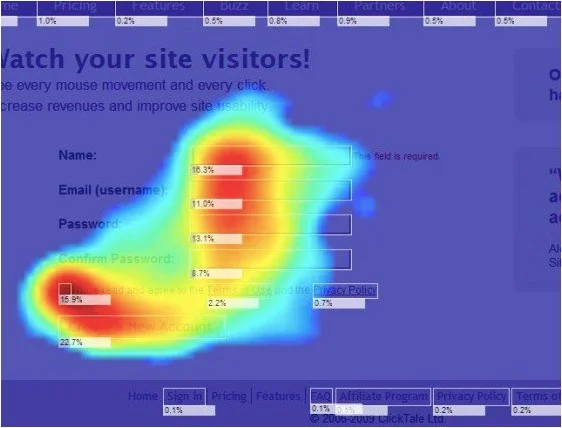
Traditional analytics can tell you what users do — such as where they exit, how many pages they view, or whether they convert — but often provide little visual context about why they behave that way. Heatmaps fill this gap by revealing ignored CTAs, confusing elements, unexpected click patterns, and sections that users never reach.
By turning thousands of interactions into clear visual patterns, heatmaps help teams identify friction points, understand engagement, and uncover missed conversion opportunities. Combined with tools such as session recordings and funnel analytics, they provide a stronger foundation for making data-driven website improvements.
What Can Website Heatmaps Reveal About Your Visitors?
Website heatmaps turn aggregated visitor interactions into visual patterns, making it easier to understand how people engage with a page. Click heatmaps show where users click or tap, helping identify popular CTAs, links, and navigation elements, as well as non-clickable elements that create confusion. Scroll heatmaps reveal how far visitors move down a page and whether important content is actually seen, while attention or move heatmaps highlight areas where users appear to spend more time or focus.
Together, these insights can uncover friction that traditional analytics may overlook. For example, a heatmap might reveal that a primary CTA is being ignored, users repeatedly click an image expecting it to be interactive, navigation attracts disproportionate attention, or most visitors leave before reaching an important section. These patterns can point to distracting design elements, confusing layouts, weak calls to action, or poorly positioned content.
However, heatmaps should not be treated as a standalone source of truth. High activity does not necessarily mean positive engagement, and a heatmap cannot explain a visitor’s intent by itself. Combining heatmap findings with conversion rates, funnel analytics, session recordings, and other behavioral data helps teams understand what is happening, why it may be happening, and which changes are most likely to improve conversions.
How Can You Use Heatmaps to Identify Conversion Problems?
Start by analyzing pages that have the greatest impact on conversions, such as landing pages, product or service pages, pricing pages, checkout screens, and lead-generation forms. Focus on the points where users are expected to take a specific action and compare heatmap patterns with conversion rates and drop-off data. This helps prioritize pages where small usability improvements could have a meaningful business impact.
Heatmaps can then be used to examine the entire journey toward conversion. Look for patterns such as visitors clicking elements that are not interactive, ignoring important CTAs, abandoning forms, or failing to reach key information because they stop scrolling early. For example, if users consistently overlook a CTA placed below a section with high drop-off, the problem may be its positioning rather than the offer itself. Similarly, excessive interaction with navigation elements can indicate that visitors are struggling to find the information they need.
Pay particular attention to the elements directly involved in conversion:
- CTAs: Are users noticing and clicking the primary action?
- Forms: Which fields or sections cause users to stop engaging?
- Navigation: Are visitors repeatedly searching for important pages or options?
- Product or service information: Do users reach the details needed to make a decision?
- Page content: Are important sections being ignored or never viewed?
However, a heatmap pattern does not automatically indicate a usability problem. Differences in behavior may be caused by device type, traffic source, audience intent, or the purpose of a particular page. Validate suspicious patterns against conversion and behavioral analytics, segment users where possible, and test proposed changes before assuming that a single heatmap reveals the cause of a conversion problem.
How Do You Turn Heatmap Insights Into Higher Conversion Rates?
Heatmap analysis is most valuable when it leads to measurable improvements rather than simply identifying interesting user behavior. Start by prioritizing issues based on their potential impact on conversions. Problems affecting high-traffic pages, key conversion points, or a large share of visitors should generally receive more attention than minor issues on low-priority pages. Consider both the severity of the friction and the potential business value of fixing it.
Once priorities are clear, turn each observation into a specific, testable change. Depending on what the heatmap reveals, this could include:
- Repositioning CTAs so they appear where users naturally focus or before major drop-off points.
- Simplifying forms by removing unnecessary fields and making the completion process clearer.
- Improving content hierarchy so important information is easier to find and scan.
- Removing distractions that compete with primary actions or lead visitors away from the conversion path.
- Reworking navigation and page structure when users struggle to find relevant information.
Avoid assuming that every change will improve performance. A/B testing allows businesses to compare the original version with a revised experience and determine whether the change actually increases conversions, engagement, or other relevant metrics. Combining heatmap observations with conversion data before and after implementation provides a more reliable basis for optimization.
For businesses that need deeper analysis or custom solutions, COAX Software can help combine behavioral data, analytics, integrations, and custom digital technologies to identify user friction and improve conversion journeys. This approach turns isolated heatmap observations into a broader optimization strategy focused on measurable website performance.
Turn User Behavior Into More Conversions
Heatmaps help businesses turn anonymous user behavior into actionable insights by showing how visitors actually interact with website content and interfaces. Instead of relying only on numbers, teams can visualize where users engage, where they encounter friction, and which conversion opportunities may be getting overlooked.
The most effective approach is continuous: analyze high-value pages, identify usability or engagement issues, implement targeted improvements, and test their impact on conversion metrics. By combining heatmap analysis with behavioral analytics and ongoing experimentation, businesses can create more user-focused experiences and steadily improve website performance and conversion rates.


